
Start with a theme, not a greatest-hits list
Jordan's most recognizable places are often presented as a checklist: Petra, Jerash, Wadi Rum, Mount Nebo, the Dead Sea. That can help a first travel plan, but it leaves a destination team with a harder question: how do five major places become one experience visitors remember rather than five pins they race between?
The answer is not a generic quiz at every landmark. It is a locally owned editorial spine—one question or theme that changes as visitors move between places—and real-world stops that are safe, permitted, and operationally practical before they become chapters in a route.
A useful umbrella theme is how landscape, movement, belief, trade, and time shape a place. But the strongest version will come from Jordanian operators, historians, guides, community partners, and destination teams who can choose the stories, languages, voices, and boundaries that genuinely belong to these places.
Each landmark deserves its own locally authored Pathventure
The wider journey should not flatten five extraordinary places into one generic product. Petra, Jerash, Wadi Rum, Mount Nebo, and the Dead Sea each deserve their own Pathventure: a distinct experience shaped by people who know the place, its stories, its access realities, and its visitor rhythms.
The five-location journey can introduce the larger arc. Then locally authored routes can let visitors go deeper at each destination. That is a better promise than importing a template and hoping it fits.
- A Petra operator can own the Nabataean, water, and movement story layer.
- A Jerash operator can make civic life, archaeology, and public space legible.
- A Wadi Rum partner can set the pace and the cultural and environmental boundaries.
- A Mount Nebo or Dead Sea team can create a distinct, reflective closing experience.
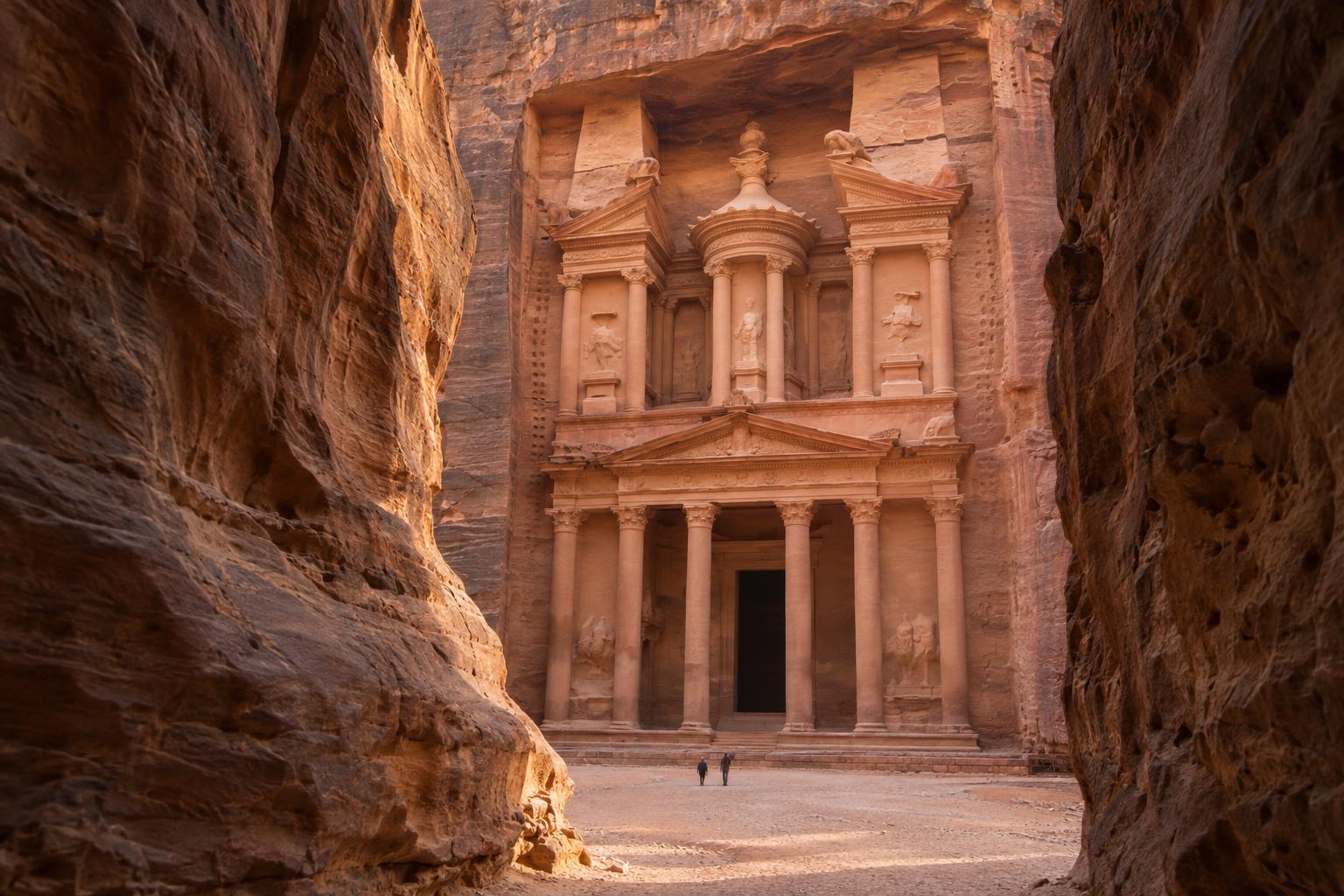
Petra: begin with movement, engineering, and arrival
Jordan's Ministry of Tourism describes Petra as a Nabataean legacy shaped by architecture, dams, and water channels. It notes that the main trail continues beyond the Treasury to the Royal Tombs, Colonnaded Street, and Qasr al-Bint. That gives a local operator far more to work with than an obligatory photo stop: a chapter about movement, exchange, water, and human ingenuity in a demanding landscape.
A route owner should select an approved, sensible pause point rather than asking visitors to interact while they are walking a crowded route. Current official visitor information must govern tickets, guides, maps, access, and opening times; those conditions can change.
Jerash: make the scale of public life visible
Jerash offers a different kind of chapter: streets, spaces, and the infrastructure of a city. Rather than treating it as another photo stop, a local route owner can invite visitors to notice how a public place organizes movement, meeting, commerce, performance, or ritual.
This is where a story-led sequence earns its keep. Visitors are not asked to memorize disconnected facts. They carry a question forward from Petra: what happens when movement and exchange become civic life at a much larger scale?
Wadi Rum: let the landscape set the pace
UNESCO describes Wadi Rum Protected Area as a mixed natural and cultural site with gorges, arches, cliffs, petroglyphs, inscriptions, and archaeological remains reflecting thousands of years of human interaction with the landscape. UNESCO also identifies visitor pressure, including vehicle tracks and tourism infrastructure, as an issue requiring careful management.
That is an argument for fewer, better chapters. A local partner must decide where vehicles may go, where visitors may stop, what a guide leads, what content is appropriate, and how Bedouin heritage is represented. The digital layer should never pressure a driver or rider to look at a screen while moving.
Mount Nebo and the Dead Sea: build in reflection and recovery
Every strong route needs contrast. Mount Nebo can provide a quieter, reflective pause between monumental archaeology and desert landscape: one short piece of locally approved interpretation, one observation, then room to take in the view.
The Dead Sea gives the wider journey a natural ending. Visit Jordan describes it as a natural wonder at the lowest point on earth, surrounded by desert beaches, mineral spas, and oases. That is a better finish than a final burst of trivia: a closing reflection and a final reveal that connects earlier chapters.
Both still require operational discipline. Local designers must confirm access, parking, visitor rules, water and heat planning, and a closure or weather alternative before publishing anything.
Pathventure supports the approved route; local operators own the truth of it
Pathventure is not a replacement for a local guide, transportation operator, heritage authority, or official visitor information. It is a system a local operator can use to turn an approved itinerary into a sequence: context before travel, a clear map handoff, an arrival-aware checkpoint, a prompt after the visitor has safely stopped, and a graceful fallback when conditions change.
A publishable experience needs local ownership of the story, partnership and permissions where required, confirmed travel and stop plans, current official information, a language plan, accessibility review, and a tested recovery path for closures, crowds, heat, or a missed connection.
That is the opportunity for tourism teams and local operators: not to flatten Jordan into five checkpoints, but to build a family of destination-specific experiences that each carry local knowledge while belonging to a coherent visitor journey.